


Case Study- Substack Commenters Mike S., Albus, and their Op Team.
There are times when a client of a Web Reputation Management Firm has no moral footing to stand on. When confronted with valid complaints and accusations, their primary mitigation tactic is known as "Spray-On Hair." This involves the following strategies:
Engage Complaints Using a Hegelian Dialectic with Multiple Accounts: The complaint represents the thesis. Your role is to provide the antithesis. However, this does not require good-faith debate tactics. The goal is not to uncover the truth but to obscure the negative aspects of the client’s reputation.
Focus on Insignificant Details: Attack trivial details or semantics of the complaint while ignoring its core argument.
Assume Your Facts Are Unassailable: Present your assertions as established facts. When challenged, redirect the argument to minor, insignificant details of the challenge.
Refuse Compromise: Never concede or reach consensus with the opposing side, no matter how valid their points are.
Always Get the Last Word: In every thread, ensure you deliver the final comment and declare victory. Most readers will skip to the conclusion and assume your argument prevailed if it appears plausible and is unrebutted.
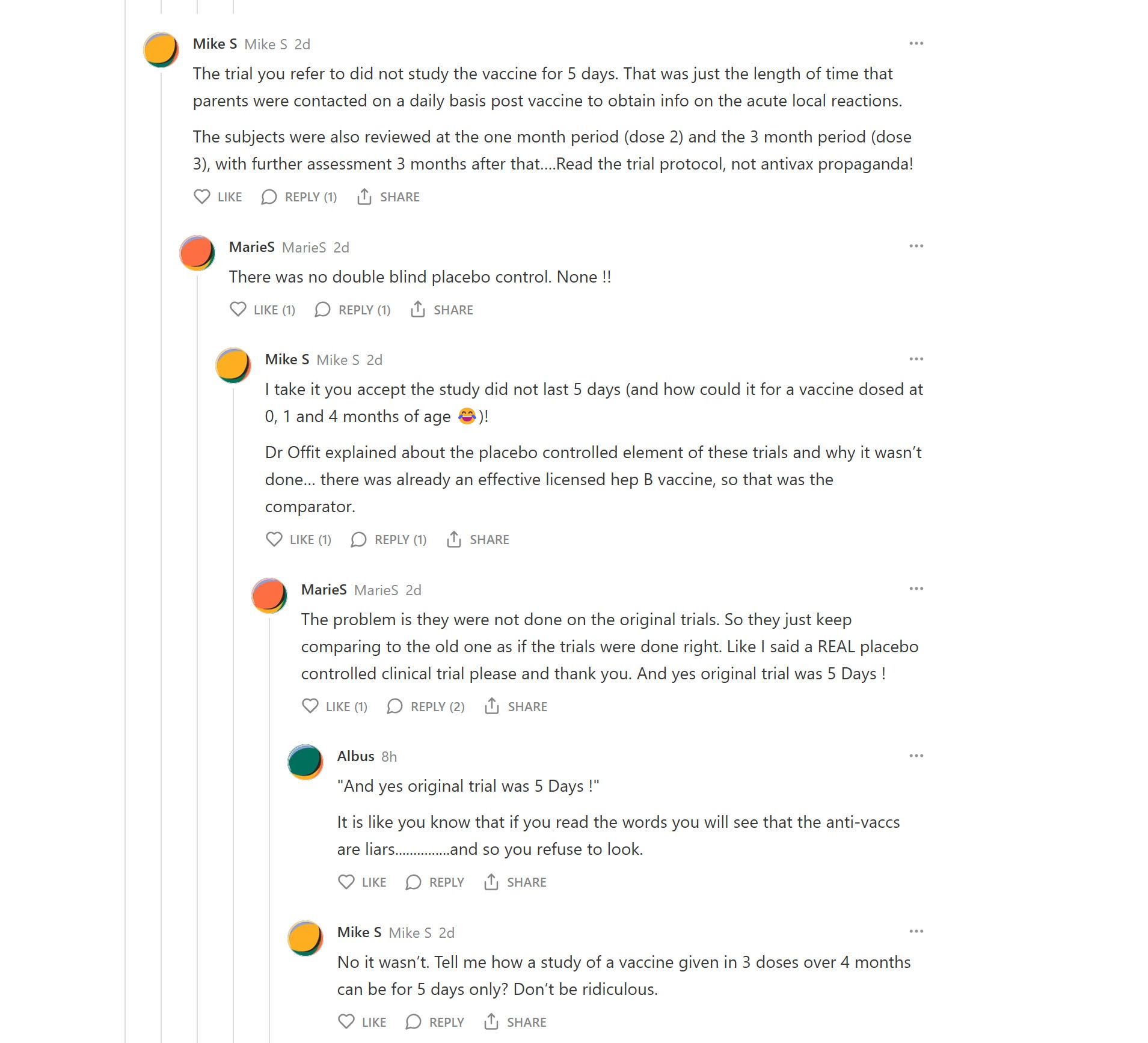
In the image provided above, this technique is demonstrated in action. The individual or team running this operation (hereafter referred to as the "Op Team") employs multiple usernames to defend the Substack account of vaccine researcher and inventor Dr. Paul Offit. On nearly every post by Dr. Offit, aggrieved individuals raise valid complaints about his work. These complaints are consistently countered by the Op Team’s primary accounts, such as "Mike S" and "Aldous," among others.
Background on the Complaint
One frequent criticism from parents and loved ones of vaccine-injured children is that none of the vaccines on the CDC’s childhood vaccination schedule have been properly trialed using an inert placebo control group. In the highlighted thread, the original complaint focuses on a trial for the Hepatitis B vaccine, which featured an initial five-day observation period and lacked a true placebo. Instead, it was tested against another vaccine for comparative safety.
The core of the complaint is that while medical therapeutics are required to be tested against an inert placebo, such as saline, before public release, vaccines are not held to the same standard. They can be tested against any formula the pharmaceutical company selects. By choosing toxic formulas for the control group, safety signals can be effectively obscured in a comparative trial. For example, if both trial groups suffer equally harmful outcomes, the investigators can conclude there is no evidence of harm from the new vaccine.
The Op Team's Response
When confronted with this valid concern, how does the Op Team react? By attacking an irrelevant detail—in this case, the five-day observation period mentioned only to identify the specific trial being discussed. As shown in the example, the Op Team repeatedly challenges the observational window's validity, which has no bearing on the main issue: the absence of an inert placebo in the trial. By focusing on this minor descriptor, the Op Team diverts attention from the substance of the complaint until the original poster stops responding. They then declare victory and move on.
The Nature of Bad-Faith Debate
In a legitimate debate, opposing ideas are presented in good faith to seek the truth. Bad-faith tactics, however, are designed to obscure reality, spreading coverage over the topic to distract from the actual issues. This is the essence of web reputation management: creating a positive public perception by crafting a false image of the client’s character and achievements, masking flaws under the guise of misleading narratives, and promoting favorable stories.
Recognizing the Technique
Once you understand how "Spray-On Hair" works, you will start noticing it in many of today’s controversial discussions. This relentless form of astroturfing has significantly contributed to the divisiveness in the U.S. over the past two decades. As reputation management firms have refined their techniques and expanded their influence across ideological divides, they have fostered the illusion that compromise is impossible. Their refusal to yield, regardless of the evidence, perpetuates this divisive narrative.
A Chess Analogy
This approach can be likened to a chess player who aims not to win but to force a draw. Such players aren’t genuinely competitive; they are simply a frustrating waste of time for their opponents. While not outright cheating, their refusal to engage meaningfully undermines the spirit of the game and diminishes the experience for everyone involved.
Epilogue- On the Op Team and Their Lack of Professionalism in Execution
The Op Team’s unprofessional execution often reveals the operation's nature. They frequently break the "fourth wall," responding from the wrong accounts or failing to diversify usernames to conceal the extent of their activity. A single comment section on an Offit article exposes the extraordinary time and effort—likely involving one to three full-time individuals—dedicated to applying this "Spray-On Hair" technique. No genuine actor would invest so many hours each day in such exhaustive coverage. This lack of variation in usernames and narrative voices highlights the Op Team’s inexperience and lack of skill and professionalism.
Coming soon- Further explanations of common Web Reputation Management Tactics in the hopes of educating the public about a weapon which has been effectively used against them for decades.